Why We Are Building Ribix, an Open-Source Router OS
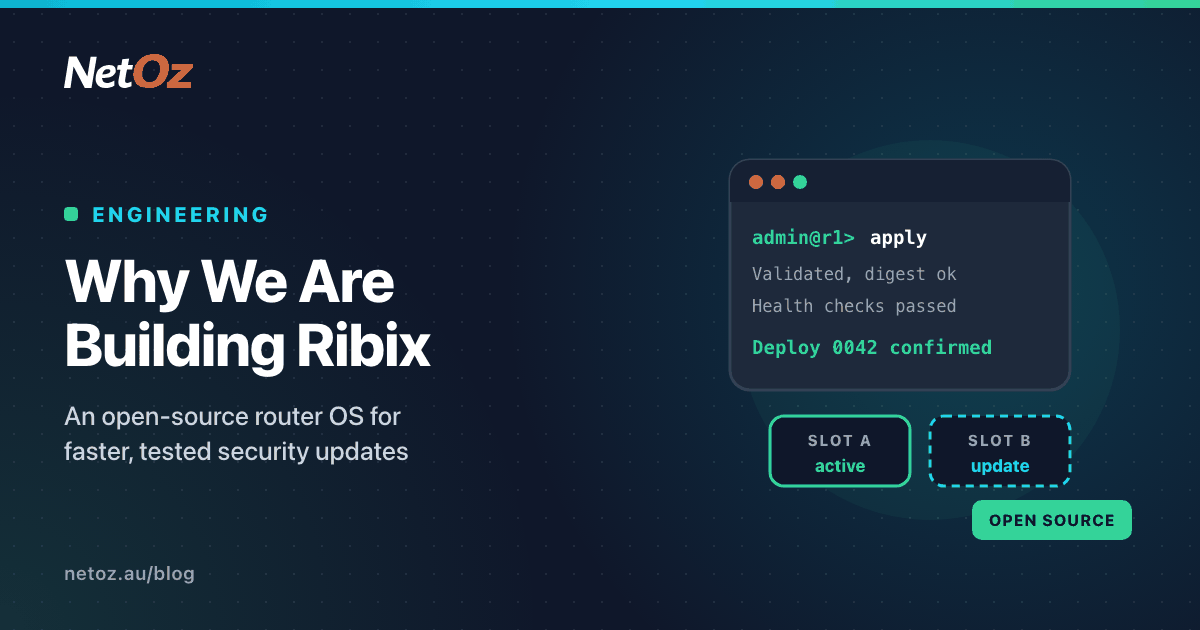
Please read first. Ribix is a work in progress. It is not used in production, and none of our customers' traffic runs through it. For now, we plan to use it only on internal services that are low traffic and low risk, and only once it has proven itself there. Our production network stays on its current platform until then.
This week alone we have published security alerts for NGINX, WordPress and PHP. Critical fixes now arrive weekly rather than every few months. Some of them were found with AI tools, and attackers have access to the same tools.
That changes what we need from the software we run. It is no longer enough for a fix to exist. We need to be able to build it, test it and deploy it quickly, without taking risks with the network to do so.
Routers are where that has been hardest for us. That is why we have started building Ribix.
What Ribix is
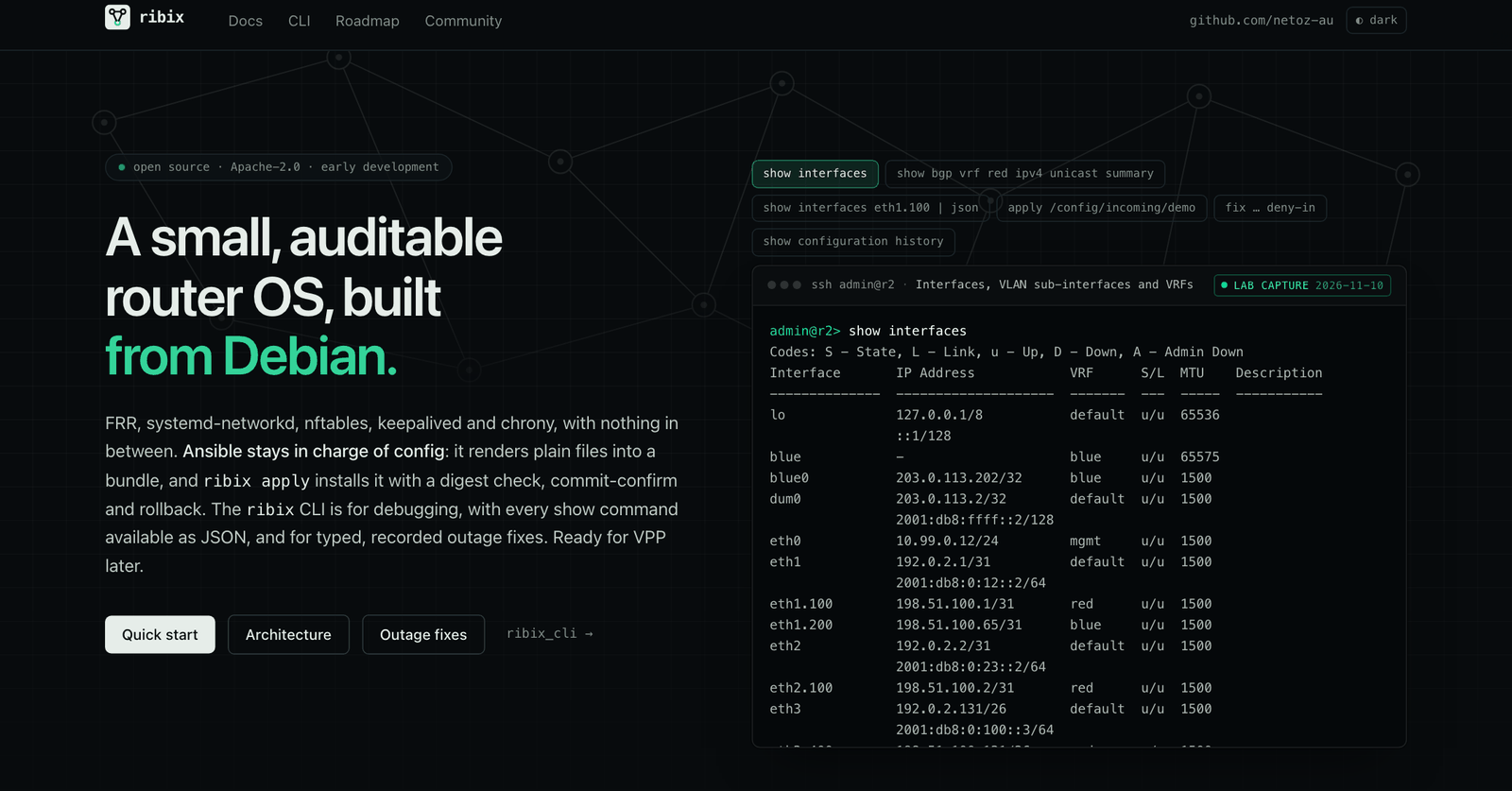
Ribix is a small router operating system built on Debian. It uses the same well-known open-source software that most Linux routers already rely on:
- FRR for BGP, OSPF, BFD and static routing;
- systemd-networkd for interfaces, VLANs and VRFs;
- nftables for filtering;
- keepalived for VRRP, and chrony for time.
What Ribix adds is a safe way to install configuration and updates, and a command-line tool, ribix, for the moments when something is wrong.
- Configuration comes from automation, not from typing on the router. A tool such as Ansible renders ordinary config files into a "bundle". The router checks it, installs only what changed, and keeps the change pending until it is confirmed. If it is not confirmed, or a health check fails, the router puts the previous config back by itself.
- Every file is a normal Linux config file. Any network engineer can read
frr.confornftables.conf. There is no hidden layer between you and the software. - The CLI is for debugging and outages. It has familiar
showcommands, and every command can return JSON for scripts and monitoring. You can see real CLI sessions from the lab on the Ribix website.
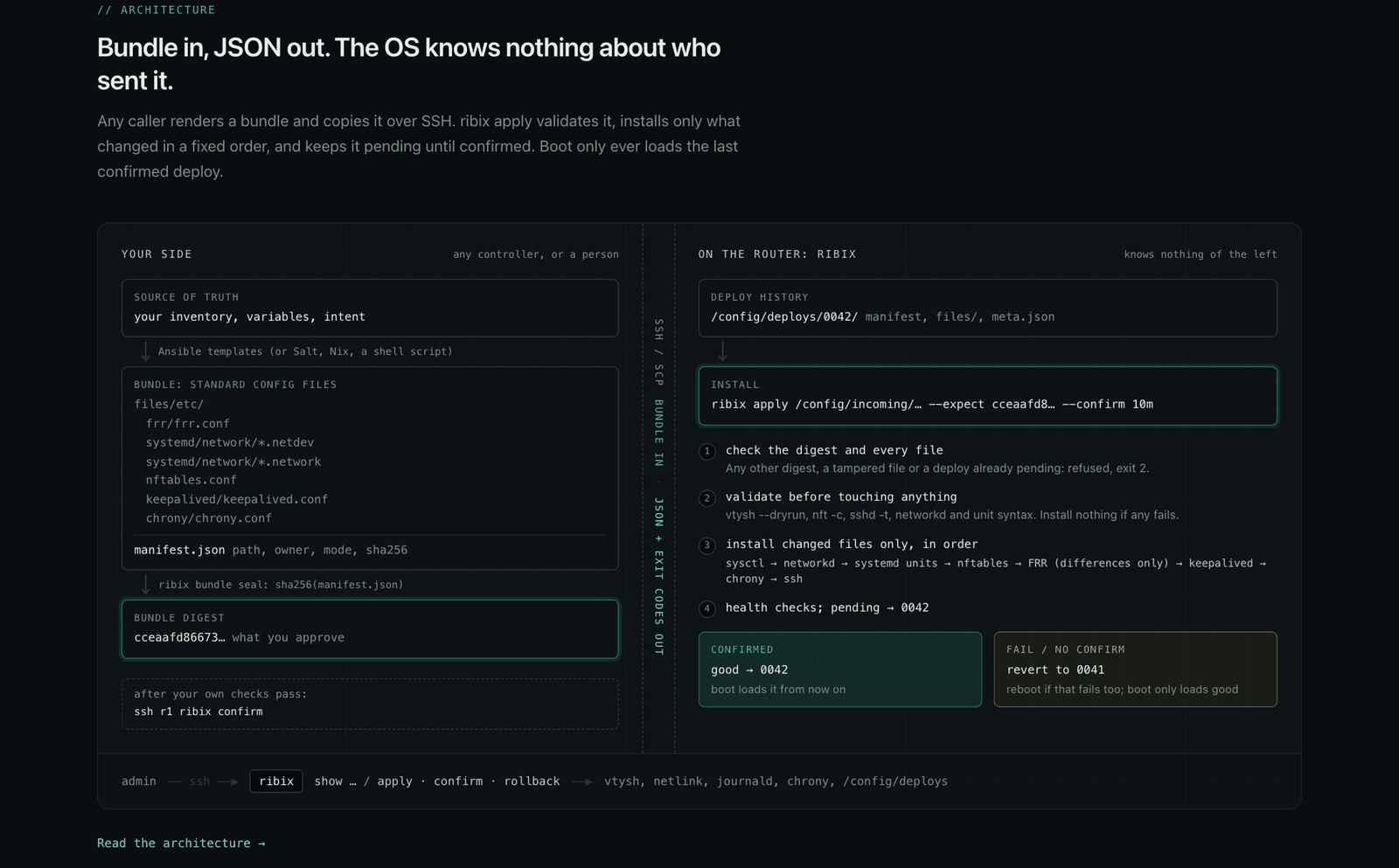
The Ribix architecture guide explains each step in detail.
Why: security fixes on our schedule
The main reason is speed. When a serious flaw is found in the Linux kernel, OpenSSH or the routing software, we want to be able to ship the fix to our routers within hours of Debian releasing it, not weeks later when an appliance vendor gets to it.
With router platforms we do not control, we have had to wait for the vendor to ship a fixed kernel, and work around the platform to apply our own security measures. Ribix is designed so that does not happen:
- The whole image is built from pinned, published Debian packages. Two builds of the same version are byte-for-byte identical, so we know exactly what is on a router.
- A security watch notices new Debian security fixes, rebuilds the image, runs it through the full test lab, signs it, and only then publishes it.
- Routers install updates in a maintenance window, onto a second system slot. If the new image does not pass its checks after a reboot, the router goes back to the previous image by itself.
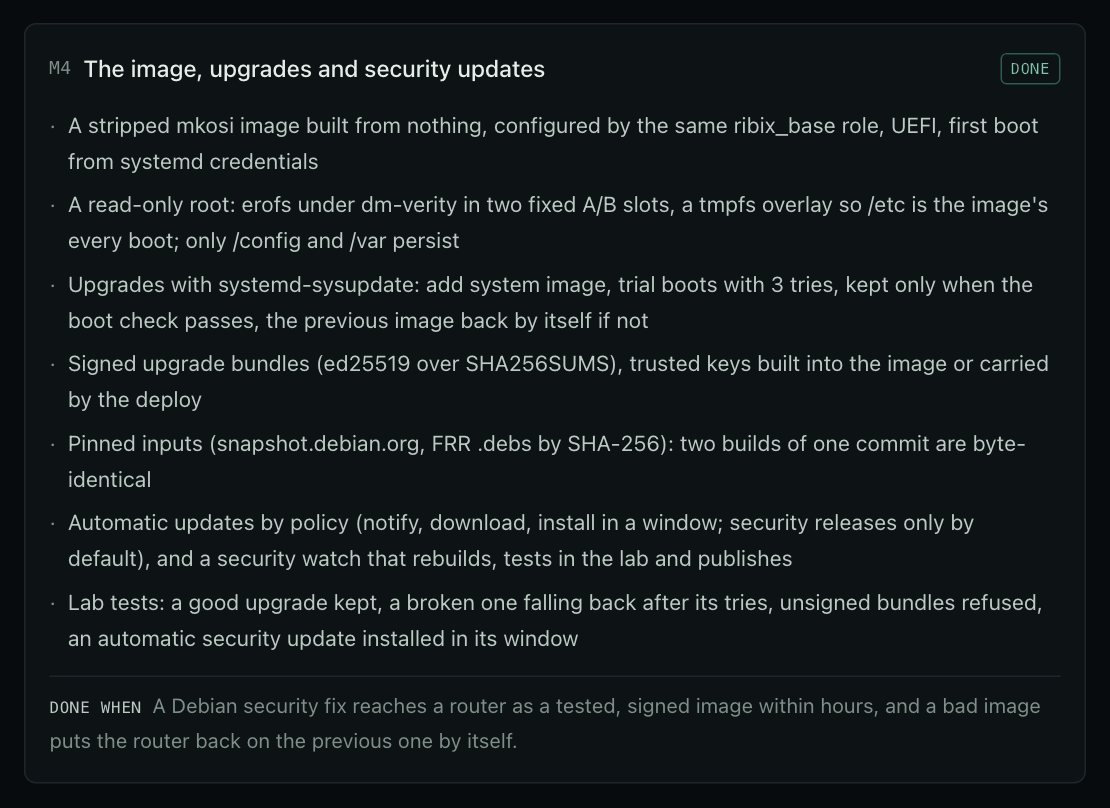
The Ribix roadmap shows what is done and what comes next.
Why: more automation, with guard rails
We keep automating more of how we run our network: configuration generated from a single source of truth, changes reviewed as a plan before they are applied, and drift detected automatically. Ribix is the next step in that direction. The router is built to be driven by automation, and to protect itself when automation gets something wrong:
- A change is refused unless its digest matches the one that was approved.
- Every config is validated before anything is touched.
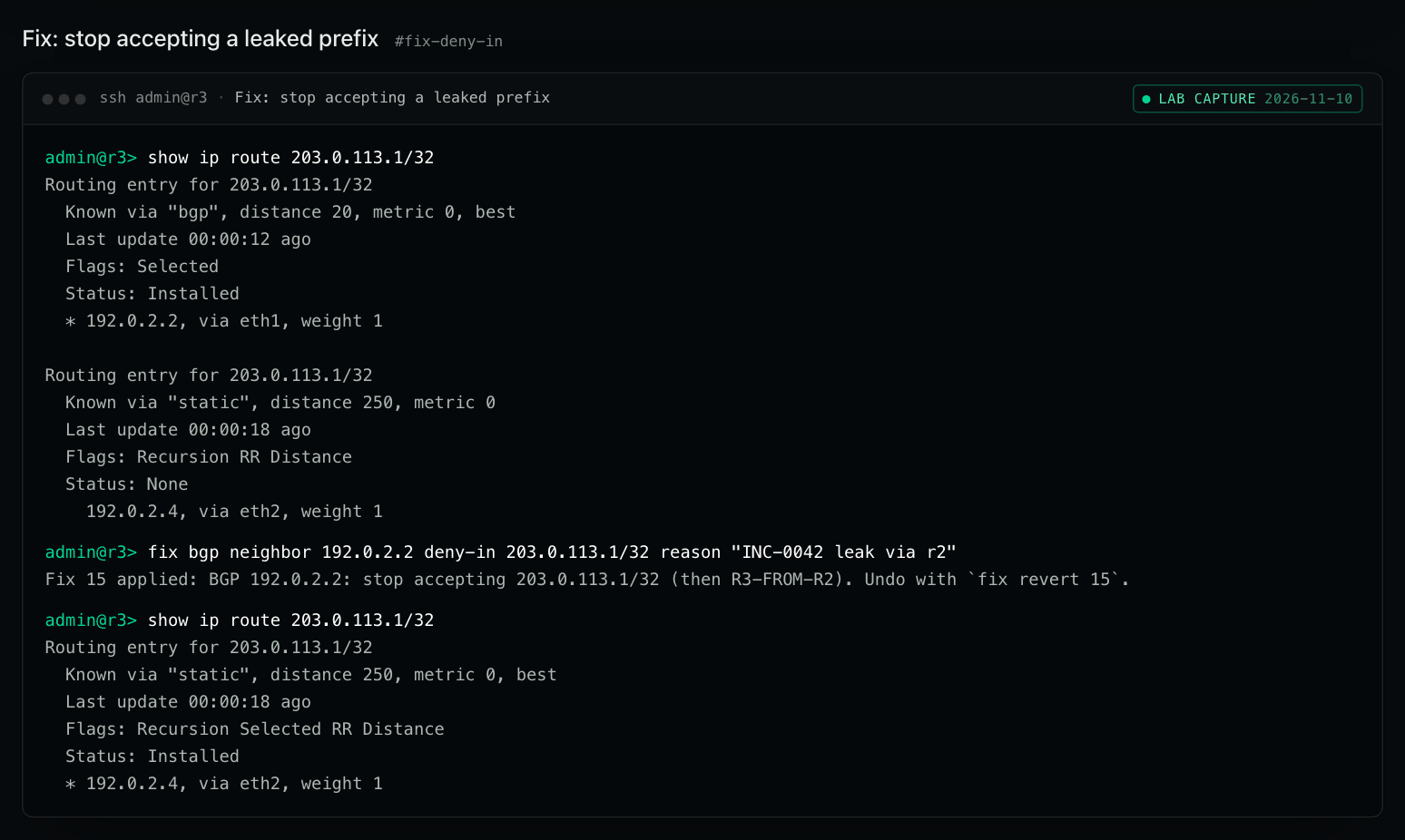
- Changes made by hand during an outage are recorded, with a reason and an exact undo.
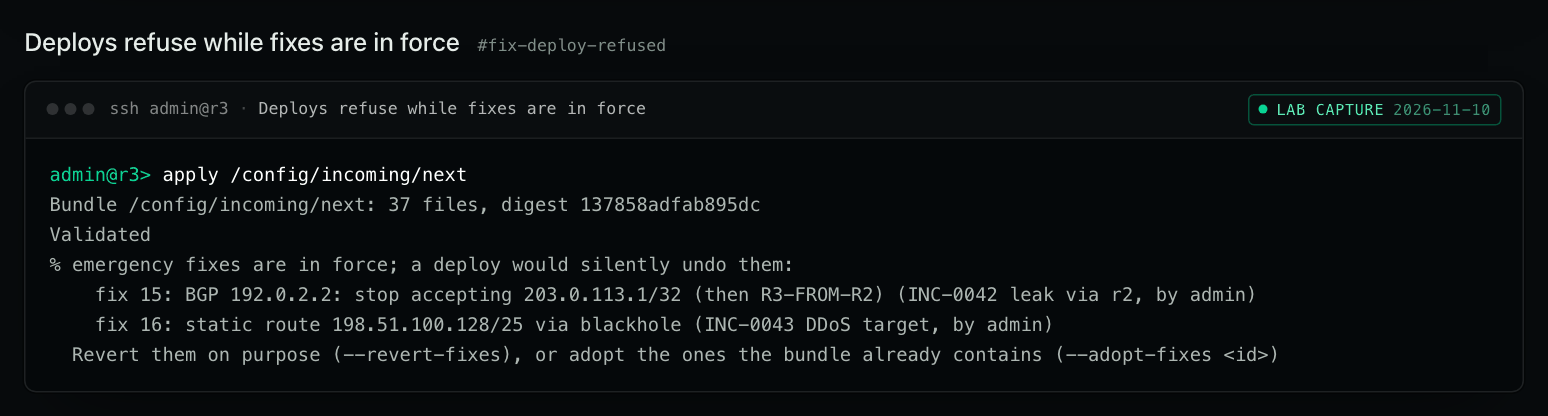
- An automated deploy will not quietly overwrite an emergency fix that is still in place.
Outages still happen, and people still need to fix things at 3am. Ribix gives them typed "fix" commands that are checked, recorded and reversible, rather than an unlogged change that is forgotten by morning. The outage fixes guide lists every fix and how it is undone.
Why open source
We have built our business on open-source software: Linux, Debian, FRR, NGINX, PHP and many others. Community projects like these are some of the best software there is, because anyone can read them, test them and improve them.
So Ribix is open source too, under the Apache-2.0 licence. It is deliberately generic:
- It does not depend on anything NetOz.
- It has no knowledge of our network.
- It works with any automation tool, or with a person and
scp.
Our own configuration and tooling stay private. The OS itself is something anyone running a small network should be able to use, inspect and improve.
Built with AI, tested like it matters
Ribix is being built with heavy use of AI. Most of the code, tests and documentation have been written with AI assistance, directed and reviewed by a person. We are open about that, because it is a big part of why a small team can attempt a project like this at all.
It is also why testing is at the centre of the project. AI can write a lot of code quickly. Our job is to make sure that code is right. Every feature has to prove itself in a virtual test lab of three Ribix routers running the exact image a real router would run:
- BGP over IPv4 and IPv6 in several VRFs, VRRP gateways, firewalls, NAT, DHCP, WireGuard and more.
- Failure on purpose: bad configs, tampered bundles, rebooting in the middle of a deploy, and boot loops.
- Real upgrades: a good image is kept, a broken image falls back to the previous one, and an unsigned image is refused.
The current suite runs 257 checks, and all of them must pass before a change or an image is accepted. The screenshots in this post are captures from that lab, not mock-ups.
What it is not, yet
To be clear about where Ribix is today:
- It is not in production. No NetOz customer traffic runs through it.
- It is early. Features, commands and file formats may still change without notice. Expect rough edges and bugs.
- Our plan is cautious. It will be used first on internal services that are low traffic and low risk. It will only move further when it has proven itself there, over time, with monitoring and a fallback in place.
- There is no warranty. If you try it yourself, use a lab, not a network you depend on. The quick start sets up a three-router lab under QEMU.
- It is not trying to replace large carrier routers. It is aimed at small networks, edge and branch sites, labs and homelabs.
What happens next
The next steps are:
- publishing the code alongside the documentation;
- opening a community forum for questions, bug reports and feature requests;
- running the automated security release process unattended.
We will write about how it goes, including what goes wrong. To follow the project, see ribix.net.
If you run a small network and are interested in Ribix, or in how we approach automation and security updates for our customers, get in touch.
Need a hand with hosting or networking?
NetOz provides VM, managed and email hosting, DNS and colocation from a NextDC Tier IV facility in Adelaide.