Australian Data Sovereignty and the Privacy Act: Where Should Your Business Data Be Hosted?
"Is our data stored in Australia?" is a question more Australian businesses are being asked by customers, boards and insurers. It is also a question many business owners cannot answer with confidence, because their data is spread across email, accounting software, CRM, backups and file sharing, each with its own provider and data centres.
This post explains, in plain English, how the Privacy Act 1988 (Cth) relates to where you host data, what "data sovereignty" actually means, and how to think about the decision for your own business.
This is general information, not legal advice. Privacy obligations depend on your organisation, industry and contracts. The Privacy Act has been the subject of significant reform, with more changes proposed. Check the latest guidance from the Office of the Australian Information Commissioner (OAIC) and get professional advice for your situation.
Sovereignty, residency and jurisdiction
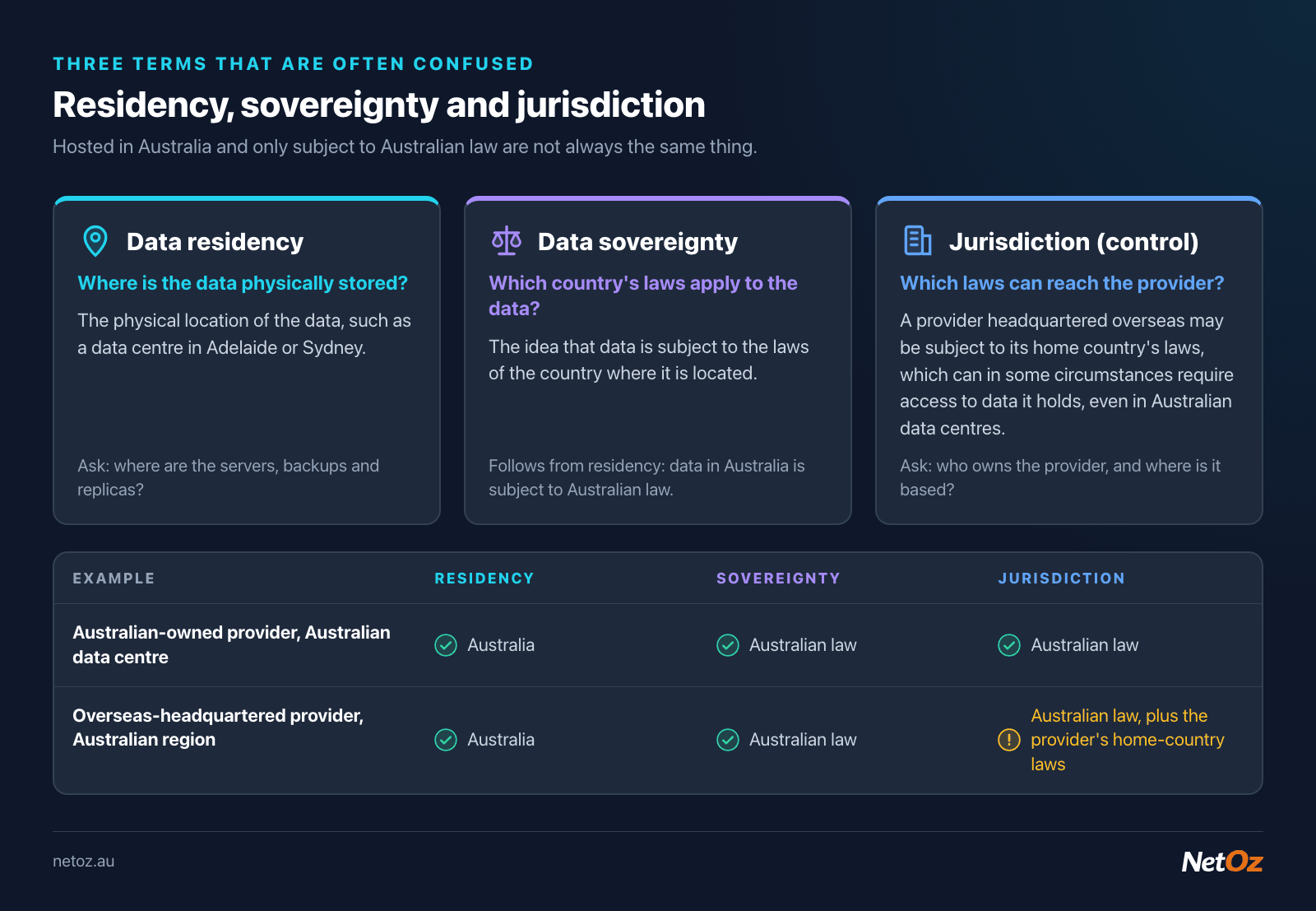
These terms are often used interchangeably, but they mean different things:
- Data residency is the physical location where data is stored, for example a data centre in Adelaide or Sydney.
- Data sovereignty is the idea that data is subject to the laws of the country where it is located.
- Jurisdiction (or control) is about which laws can reach the provider. A provider headquartered overseas may be subject to its home country's laws, which can in some circumstances require access to data it holds, even data stored in Australian data centres.
So "hosted in Australia" and "only subject to Australian law" are not always the same thing. For some businesses that difference does not matter. For others, especially those handling government, health or highly sensitive data, it matters a great deal.
Does the Privacy Act apply to you?
The Privacy Act and its 13 Australian Privacy Principles (APPs) apply to Australian Government agencies and to most organisations with an annual turnover of more than $3 million.
Many smaller businesses are exempt, but not all. Some small businesses are covered regardless of turnover, including (among others) health service providers, businesses that trade in personal information, and contracted service providers to the Commonwealth. The exemption rules have also been under review as part of the reform process, so check the OAIC's current guidance rather than assuming you are exempt.
Even if you are exempt, your customers or contracts may require you to follow the APPs, and following them is a sensible baseline for handling personal information well.
The principles that matter most for hosting
All 13 APPs matter, but three are especially relevant to where and how you host data.
APP 1: Open and transparent management
You need a clearly expressed, up-to-date privacy policy. Among other things, it should say whether you are likely to disclose personal information to overseas recipients and, if practicable, the countries where they are likely to be located. If your privacy policy says one thing and your actual systems do another, that is a problem in itself.
APP 8: Cross-border disclosure
APP 8 applies when you disclose personal information to someone overseas. Before doing so, you generally must take reasonable steps to ensure the overseas recipient does not breach the APPs, usually through contractual terms. Importantly, under section 16C of the Act you can remain accountable for what the overseas recipient does with the information.
There are exceptions, for example where the recipient is subject to a law or binding scheme that provides substantially similar protection and the individual can enforce it, or where the individual has consented after being expressly informed. The reforms introduced a mechanism for the government to prescribe countries and schemes with substantially similar protections, so this area may continue to change.
A nuance worth knowing: the OAIC's guidance indicates that giving information to an overseas cloud provider purely for storage, where the provider does not access it and you keep effective control, may be treated as a use rather than a disclosure, in which case APP 8 may not be triggered. Whether that applies depends on the specific arrangement and contract, which is exactly why many businesses find it simpler to keep personal information onshore with a provider whose access to the data is clearly limited.
APP 11: Security of personal information
APP 11 requires you to take reasonable steps to protect personal information from misuse, interference and loss, and from unauthorised access, modification or disclosure. It also requires you to destroy or de-identify personal information you no longer need, unless a law requires you to keep it.
"Reasonable steps" depends on the circumstances, including the sensitivity of the information and the size of your organisation. The OAIC's guidance points to measures across governance, ICT security, access controls, data breach response and physical security. Recent reforms clarified that reasonable steps include technical and organisational measures.
Hosting location feeds into this. You need to know where your data is, who can access it, how it is backed up and how quickly you can respond if something goes wrong.
The Notifiable Data Breaches scheme
Since 2018, organisations covered by the Privacy Act must comply with the Notifiable Data Breaches (NDB) scheme. In summary:
- An eligible data breach is unauthorised access to, or disclosure or loss of, personal information that is likely to result in serious harm to one or more individuals, where you have not been able to prevent that likely harm through remedial action.
- If you suspect an eligible breach, you must carry out a reasonable and expeditious assessment, and take all reasonable steps to complete it within 30 days.
- If it is an eligible breach, you must notify the OAIC and affected individuals as soon as practicable.
From a hosting point of view, the NDB scheme raises practical questions:
- Will your provider tell you promptly if they have a security incident affecting your data? Check the contract.
- Can you get the logs you need to work out what was accessed?
- Do you know every place the data lives, including backups, replicas and test copies?
- Who do you call, and in what time zone?
A breach at your provider can still be your notifiable breach.
Reform: check current guidance
The Privacy Act has been under review for several years. In late 2024, Parliament passed the Privacy and Other Legislation Amendment Act 2024, which made a first set of changes, including stronger OAIC enforcement powers, a new statutory tort for serious invasions of privacy, transparency requirements for certain automated decisions, and work towards a Children's Online Privacy Code. Further reforms have been proposed and discussed by government.
Because this area is changing, treat any article (including this one) as a starting point, and check the OAIC website for the current position.
Other rules that can affect location
Beyond the Privacy Act, some sectors and contracts carry their own requirements, for example:
- Government work. Commonwealth agencies and their suppliers may need to use hosting that meets government frameworks, such as the Hosting Certification Framework, and data classification rules.
- Health information. Health information is "sensitive information" under the Privacy Act, and some health record systems and state laws carry specific requirements.
- Financial services. APRA-regulated entities have prudential standards covering information security and the management of material service providers, including offshore arrangements.
- Contracts and tenders. Increasingly, customer contracts and tenders ask suppliers to confirm data is stored in Australia.
If any of these apply to you, get advice specific to your sector.
So, where should your data be hosted?
There is no single answer, but these questions will get you most of the way:
- What data do you hold? Personal information, sensitive information (health, biometric and so on), financial records, intellectual property? The more sensitive, the stronger the case for keeping it onshore and under clear control.
- Where is it today? List every system: email, file storage, CRM, accounting, website, backups. Ask each provider where data is stored, where it is backed up, and where support staff who can access it are located.
- Who has jurisdiction? Is the provider Australian-owned, or headquartered overseas with an Australian region?
- What do your customers and contracts require? Read the contracts. Ask your largest customers.
- What does your privacy policy say? Make sure it matches reality, especially on overseas disclosure.
- Can you respond to a breach? Can you get logs, isolate systems and talk to someone quickly?
For many Australian businesses, the practical outcome is a mix: keep personal and sensitive data, and its backups, with an Australian provider where the location and access are clear, while using global services for things that carry less risk.
Quick self-check
A few things you can verify yourself today:
- Look up where your website and mail servers actually are with our DNS lookup and MX lookup, then use the WHOIS lookup on the IP addresses to see which network owns them. This does not tell you everything (a provider can use Australian IPs and still be offshore-controlled), but it is a useful first pass.
- Run your website through our website security check to spot basic HTTPS and header issues, which are part of the "reasonable steps" picture.
Keeping it in Australia
If you want your data hosted onshore with an Australian-owned provider, NetOz runs from a Tier IV data centre in Adelaide with 24/7 support. Our data sovereignty page explains our approach, and services such as email hosting and VM hosting can help bring key systems home. Contact us for a no-pressure conversation about what would suit your business.
Need a hand with hosting or networking?
NetOz provides VM, managed and email hosting, DNS and colocation from a NextDC Tier IV facility in Adelaide.